

- News
- Speech by Oliver Väärtnõu at the Opening of the Business Season at Ämari Air Base on 5 September 2026
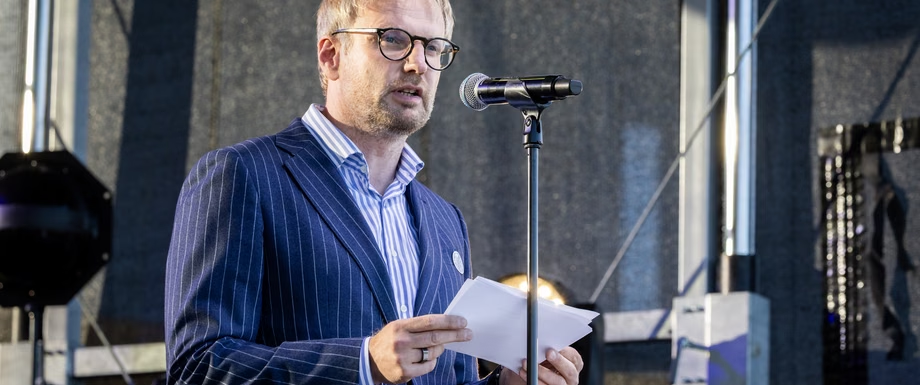
Speech by Oliver Väärtnõu at the Opening of the Business Season at Ämari Air Base on 5 September 2026
Dear members and friends of the Estonian Chamber of Commerce and Industry, distinguished guests!
Welcome to another opening of the Chamber’s business season, and many thanks to Ämari Air Base for once again hosting us.
It is good to see so many entrepreneurs and people involved in business here. We all know that business does not really have a season. For an entrepreneur, one season does not end and another begin – work, decisions and responsibility continue all the time.
But the beginning of the business season gives us a good opportunity to pause for a moment. To look back at what we have done, discuss the problems currently affecting our economy and society, and consider the direction in which Estonia could move forward.
Ladies and gentlemen, today I want to talk about three things.
First, about what the Chamber has done this year. Second, about some of the problems currently affecting Estonian business and society more broadly in a very direct way. And third, about the fact that the Riigikogu elections will take place next March, which means that we all have reason to ask what kind of Estonia we actually want.
This year has been a very busy one for the Chamber! We have organised nearly one hundred different events, seminars and visits. These are large numbers, but the number itself is not the objective. What matters is that through these events entrepreneurs meet one another, exchange experiences, find cooperation partners and have a say on issues that affect their everyday activities.
Another figure is perhaps even more telling. This year, the Chamber’s lawyers have already prepared and sent more than 170 opinions and proposals to ministries and Riigikogu committees. That is around 30 more than at the same time last year. We do not prepare these opinions because a large number is somehow important in itself. In fact, this figure shows just how much legislation is being produced in Estonia and how much reason entrepreneurs have to participate in that process.
The Chamber’s mission is to stand up for the common interests of entrepreneurs. And this must also be done when a particular issue is not the most important one for a specific company today. That is because the business environment is shaped by thousands of small and large decisions made by the state every day. This volume of legislation continues to concern us. And in my view, there is one very important question here: does the state trust its people and entrepreneurs?
We seem to have developed a habit of thinking that the solution to every new problem must be a new regulation, a new requirement, a new report or a new control mechanism. But perhaps we should more often ask the opposite question as well: what could the state refrain from doing?
At this point, I would like to recognise the work that has been done over the past year to reduce bureaucracy. As a result of the proposals made by the Economic Growth and Efficiency Council, around 150 bureaucratic requirements have now been abolished, and during the 2026 spring session the Riigikogu amended 13 Acts as a result of this work.
That is good. And that is exactly what should be done!
But I am convinced that a single campaign is not enough. We may find one hundred or two hundred requirements that can be abolished. And it is very good if we do so. But my question is: what happens next? Because if the same mindset remains within the administrative apparatus, sooner or later new requirements will replace those that have been abolished. Reducing bureaucracy therefore cannot simply be one project or one campaign. We need a change in the state’s administrative culture.
Before introducing any new obligation, report or permit, the first questions should be:
- Is it genuinely necessary?
- Does it provide sufficient benefit to society?
- Could the same objective be achieved more simply?
- And perhaps most importantly: can we place more trust in people?
Some time ago, I noticed a good example from Finland. Requirements for building permits for smaller outbuildings of less than 30 square metres have recently been simplified there. One might ask: what difference does a single outbuilding of less than 30 square metres make? In fact, it matters a great deal. Not because of the building itself, but because of the message the state sends to its people.
The state gives people greater freedom to make their own decisions. It is a small change, but behind it lies a major principle – trust. These are precisely the kinds of examples we would like to see more of in Estonia as well. I am convinced that if we want to be a prosperous country, we must also increase trust. Simply adding more regulations and controls will not make the economy stronger.
But trust is not important only in our relationship with the state. It is also important in our relationships with people. And that is why I want to talk about people.
Ladies and gentlemen,
the business environment is not only about taxes, regulations or energy costs. Ultimately, people are at the heart of business. And perhaps one of the most important questions for Estonia in the coming years is whether our people’s skills and readiness to learn will change as quickly as our economy.
Technology is developing rapidly. Artificial intelligence is already changing the content of work and the structure of the labour market. Some jobs are disappearing, many jobs are changing, and entirely new occupations are emerging. This means that competitiveness is no longer only a question of what a company produces or which technology it uses. Increasingly, it is a question of how quickly people are able to learn.
In recent years, the Chamber has paid a great deal of attention to young people, education and learning. We have recognised young leaders, launched a young leaders’ club and met almost every week with different school leaders and people driving developments in education.
Why?
Because these are the people on whom the state of Estonia’s economy and society in ten or twenty years’ time will depend to a very large extent.
And here is one figure that I believe we should think about seriously. Estonia has one of the highest youth unemployment rates in the European Union – according to the latest Eurostat statistics, 26.1 per cent. This is 11 percentage points higher than the European Union average. In Germany, the same figure is 7.2 per cent, in Poland 12 per cent and in Latvia around 15 per cent.
We talk a lot about how young people should learn. But we should probably also talk more about how young people move from education into work. A young person’s first job is very important. It is not simply their first salary. It largely determines their trajectory – it is their first encounter with responsibility, work habits and a team.
And entrepreneurs also have a role here. We cannot expect schools to produce ready-made employees and the state to solve the labour problem. As entrepreneurs, we must also be prepared to invest in young people, give them their first opportunity and teach them on the job. At the same time, the education system must take better account of the kind of people the Estonian economy needs.
Not every young person needs to go to university. Nor should this be an objective in itself. Good vocational and professional education is just as important to the Estonian economy as good general and higher education.
If entrepreneurs constantly talk about skills shortages, labour shortages and productivity, we cannot at the same time allow vocational education to become secondary within the education system. We are therefore concerned about a situation in which we speak in fine words about the importance of education while the share of funding allocated to vocational education is decreasing. If we have set the goal of high-quality education, that goal must also be followed by real funding.
In the coming years, the Chamber wants to work with the Ministry of Education and Research to place greater emphasis on developing employees’ skills. We want to find solutions that make developing people easier, more practical and more effective for entrepreneurs. Because, as I have already said, we are no longer competing only through products, prices and technology. We are competing through how quickly our people can learn and adapt to change.
And finally, the third topic – next year’s Riigikogu elections.
Over the coming months, all political parties will promise us many things. Our task as entrepreneurs is to ask them not only what they want to do, but above all how they intend to do it.
- What is Estonia’s economic growth model?
- How will we increase productivity?
- How will we make the tax environment competitive and predictable for entrepreneurs?
- How will we make reducing bureaucracy a permanent part of how the state operates?
- And how will we ensure that our education and labour policies give the people of Estonia the skills that our economy actually needs?
These are not easy questions. But these are precisely the questions to which we expect answers.
The Chamber is and will remain an apolitical organisation, but being apolitical does not mean being apathetic. We plan to meet all political parties and listen to their views on business, the economy, education and public finances.
For our part, we will certainly contribute to this discussion. During the autumn, we intend to develop our own positions on tax policy, energy, education, innovation policy and other issues and share them with politicians. We expect our proposals to be taken seriously. And we also expect entrepreneurs to be trusted – not only in words, but in decisions.
Naturally, I also encourage all of you to use the coming months to ask politicians standing for election for specific positions on issues that matter to you, and I encourage you to put forward your own ideas on how to make life in Estonia better. This is our opportunity and our responsibility.
I would once again like to thank Ämari Air Base for hosting us. National defence issues are also very important to us, and entrepreneurs have a strong willingness to contribute to Estonia’s comprehensive national defence. We are ready to continue contributing our ideas and efforts to this cooperation.
And to you, dear entrepreneurs, I wish good decisions, new opportunities and success for the business season ahead. Let us hope that when we gather here again in a year’s time, we will be able to say that Estonian companies and the Estonian economy have done better.
Thank you, and have a pleasant evening!