

The state and entrepreneurs signed an agreement to develop clean industry
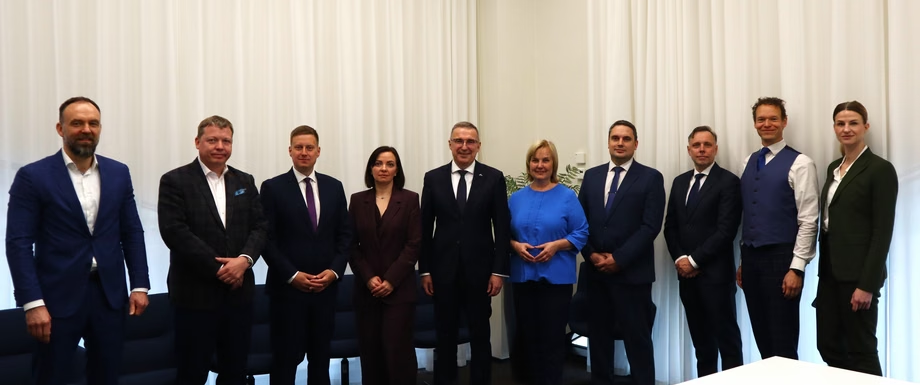
Our newsMinister of Energy and the Environment Andres Sutt and Minister of Economic Affairs and Industry Erkki Keldo, together with several entrepreneurs and business organisations, signed an agreement to jointly develop clean industry. The joint aim is to create in Estonia a broader value chain for the development and production of clean technologies, as described in the industry roadmap supplementing the Climate-Resilient Economy Act.
“Clean industry is a foundation of competitiveness, strategic independence and a clean environment. At the same time, individual strong companies are not enough; the entire strategic value chain as a whole must be centrally maintained and developed. Today's agreement is the first step and shows that entrepreneurs and the state understand this in the same way. We invite all entrepreneurs who wish to contribute to creating value chains for the development of clean industry to join the agreement,” said Minister of Energy and the Environment Andres Sutt.
Minister of Economic Affairs and Industry Erkki Keldo also presented at the signing the first practical steps that the state is taking to develop the clean industry value chain. “Clean industry gives Estonia the opportunity to shape the future in areas where our companies have potential for international growth. We do not have to do everything, but focus on the areas where we can be at the forefront, be it the maritime industry, adding value to materials or new technologies. This must be supported by joint actions by the state and the private sector: investment, innovation and export promotion. Today's agreement helps turn these directions into concrete steps. To this end, EIS will develop measures by autumn that support the development of pilot plants and the creation of value chains in Estonia,” said Minister of Economic Affairs and Industry Erkki Keldo.
According to Mait Palts, Director General of the Estonian Chamber of Commerce and Industry, the strength of the clean industry agreement is that it is based on cooperation, not commands and prohibitions. “To achieve climate targets, it is not enough for the legislator to write new goals into law and then demand that they be met. We achieve good results mainly when all parties have a clear framework and the opportunity to shape solutions themselves. If, while doing so, we keep the focus on the competitiveness of our companies and substantively take entrepreneurs' interests into account, this will help develop new technologies, grow the economy and create new opportunities that in turn bring us closer to the goals set,” said Palts.
Jaak Viilipus, Head of the Estonian Maritime Cluster, added that cooperation with the state is essential for the sector's development. “The maritime sector is an integrated value chain that extends from the metal industry and IT solutions to shipbuilding and maritime logistics. The memorandum of cooperation gives us the opportunity to develop new technologies, grow export capacity and strengthen Estonia's position as a maritime nation in the Baltic Sea region. This is an important step that will help the sector grow and develop,” said cluster head Viilipus.
To organise cooperation, a working group for the development of clean industry will be convened under the leadership of the Ministry of Economic Affairs and Communications and the Ministry of Climate. Interested parties, including key companies and business organisations, will be involved in the work of the working group. The parties will cooperate to develop and implement solutions that support the implementation of the industry roadmap and the other roadmaps of the Climate-Resilient Economy Act.
In addition to the clean industry roadmap, the Climate-Resilient Economy Act also includes roadmaps for forestry and wood products; agriculture; peat use; and transport. A climate change adaptation roadmap will be added later. The future of energy is described by ENMAK 2035. The roadmaps are the state's vision, on the basis of which the ministry prepares more detailed work plans and plans.
The general objective of the forestry and wood products roadmap is to increase the competitiveness and added value of Estonia's forestry and wood products sector so that forest management and adding value to wood also support the greenhouse gas net sequestration target as an average over a ten-year period.
The objective of the agriculture roadmap is to reduce the sector's greenhouse gas emissions in a way that preserves the sector's competitiveness and ensures food supply. Attention is also paid to adapting to climate change and ensuring the good condition of agricultural land and soil.
The peat use roadmap focuses on environmentally friendly extraction of horticultural peat, maximum valorisation of peat, creating added value through land use and further correction of greenhouse gas methodology.
The transport roadmap provides guidance to the state, local authorities and the private sector on how to shape a transport system that is energy-efficient and low-emission, supports economic development and regional balance, is accessible and supports a high-quality living environment.
The roadmaps can be viewed here.